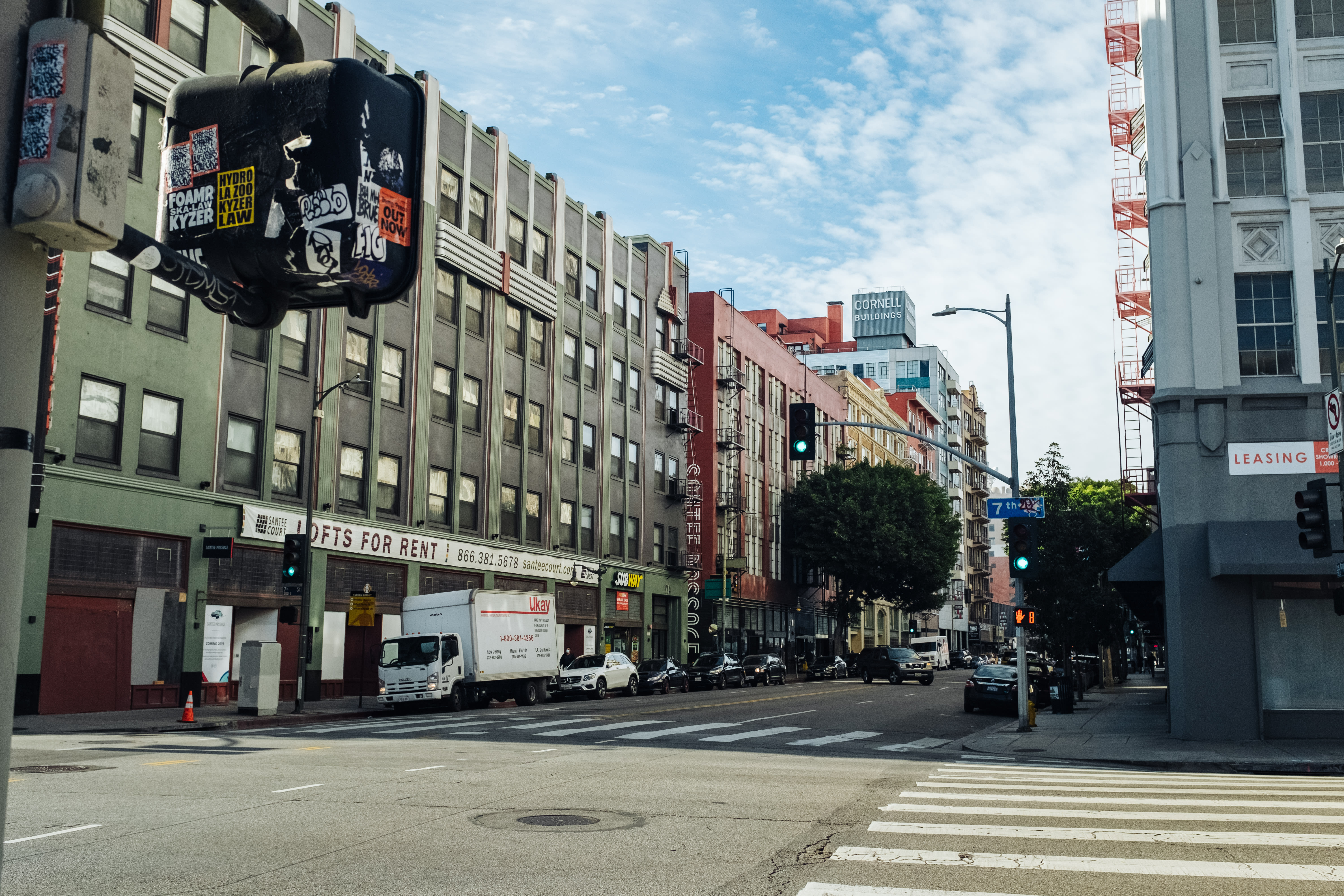
If the Arts District is Downtown LA's established creative hub, the Fashion District is its raw, energetic, and rapidly evolving counterpart. Bounded roughly by 7th Street and the 10 Freeway, this neighborhood is the historic epicenter of Los Angeles' garment industry. For buyers and investors, the Fashion District offers an incredible value proposition: authentic, heavy-concrete industrial lofts with massive historical tax benefits, often at a more accessible price-per-square-foot than the neighboring districts.
The Real Estate: Raw Concrete, Massive Scale, and High Value While the Arts District is famous for red brick and timber, the Fashion District’s architectural signature is heavy-duty industrial concrete.
The Aesthetic: Buyers here are drawn to the indestructible nature of these early 20th-century manufacturing buildings. Polished concrete floors, massive architectural columns, and triplicate sets of steel-framed casement windows define the living spaces.
Volume Over Square Footage: Automated valuations struggle here. A 900 sq. ft. loft with 12-foot ceilings feels far more expansive than a traditional apartment, and we actively market that specific architectural volume to maximize your sale or appraisal value.
Iconic Fashion District Loft Buildings
Standard neighborhood comparable sales fail here because the residential footprint is highly concentrated in a few legendary adaptive reuse conversions. We specialize in the district's premier buildings:
Santee Village (The Eckardt & Cornell Buildings): The residential anchor of the neighborhood. Built in 1917, these Mills Act-approved buildings offer some of the most dramatic rooftop amenities in DTLA, including a rooftop pool, spas, a basketball court, and a driving range.
Textile Building Lofts (315 E 8th St): A stunning 1926 Gothic Revival and Italian Renaissance brick building. Also Mills Act approved, it shares the massive rooftop amenity deck with Santee Village while offering oversized industrial windows and sweeping cityscape views.
Garment Lofts & Maxfield Lofts: Boutique, highly sought-after industrial spaces that perfectly capture the district’s rich textile heritage.
Navigating Live/Work Zoning & The Mills Act Purchasing in the Fashion District requires specialized knowledge of urban zoning and historic tax law.
The Mills Act Advantage: Buildings like the Cornell and the Textile Building carry the Mills Act designation, providing homeowners with property tax reductions that can range from 40% to 60%. We explicitly market these monthly tax savings to increase buyer purchasing power.
Live/Work Zoning: The district remains true to its manufacturing roots. Many lofts here are legally zoned "Live/Work," making it an ideal location for fashion designers, artists, and entrepreneurs who need to operate a business from their home.
The Neighborhood Vibe: Wholesale Markets & Creative Energy
The Fashion District is bustling, chaotic, and visually stunning. Documenting this neighborhood through street photography reveals a hyper-vibrant urban landscape, from the legendary wholesale vendors of Santee Alley to the massive, colorful blooms of the adjacent Flower District. The area is highly walkable, sitting just blocks from the Historic Core, and is home to an emerging, critically acclaimed culinary scene featuring spots like Holy Basil, Sonoratown, and Broken Mouth.
Frequently Asked Questions About the Fashion District
Q: Are Fashion District lofts safe and quiet? A: The neighborhood is highly active and industrious during the day due to the wholesale markets, but it becomes significantly quieter in the evenings. Buildings like Santee Village also offer 24-hour courtesy patrol and controlled access parking to ensure resident security.
Q: Do Fashion District lofts qualify for the Mills Act? A: Yes, several prominent buildings in the district, including the Cornell Building and the Textile Building, are historic landmarks approved for massive Mills Act property tax savings.
Q: Does the Fashion District have new construction condos? A: The residential market here is almost entirely dominated by historic adaptive reuse lofts (converted manufacturing warehouses) rather than new-build glass high-rises.
Map of the area


No results found

IDX information is provided exclusively for personal, non-commercial use, and may not be used for any purpose other than to identify prospective properties consumers may be interested in purchasing.
Information is deemed reliable but not guaranteed.
The listing broker’s offer of compensation is made only to participants of the MLS where the listing is filed."
Updated: 22nd October, 2026 9:13 PM (UTC)